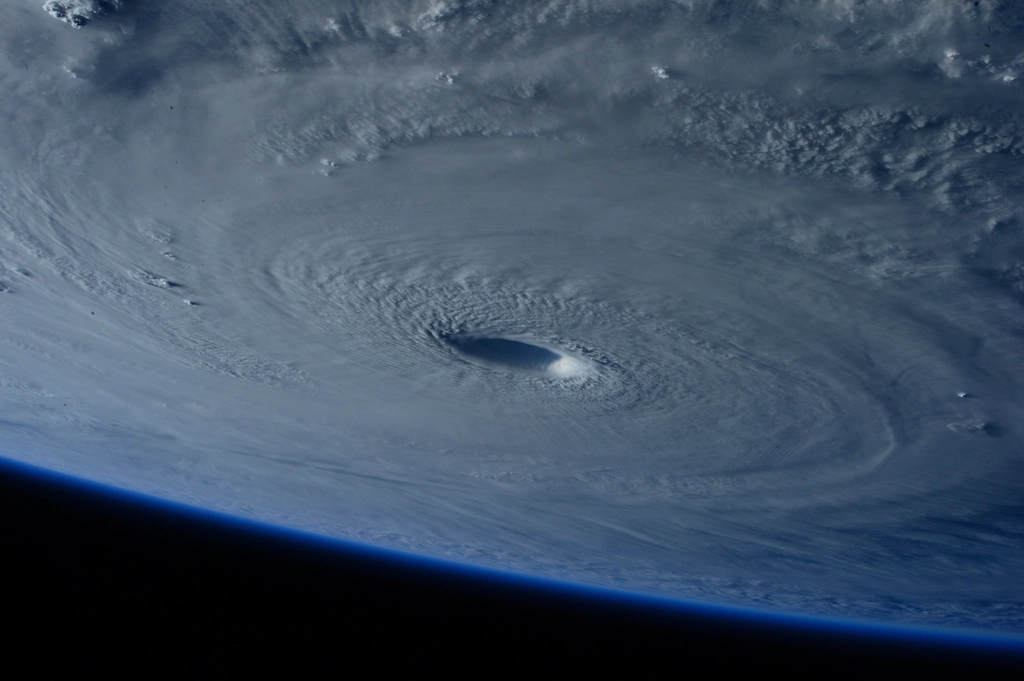
Parametric insurance pays a pre-agreed amount when a measurable event — a hurricane of a defined windspeed, an earthquake of a defined intensity — occurs at an agreed location. There is no loss adjustment and no negotiation: an independent agency reports the event’s intensity, and if it exceeds the pre-agreed trigger, payment follows within 30 business days and can be used entirely at the insured’s discretion.
We structure parametric named windstorm and earthquake cover for retail brokers, MGAs, cedents and captives with clients in catastrophe-exposed territories — most often Puerto Rico and the wider Caribbean, where it sits naturally alongside our deductible buy-down work. This is an area we are actively developing, and the worked examples below are drawn from real indications we have produced.
How parametric insurance works
A parametric policy replaces the loss-adjustment process with a measurement. The contract defines a triggering location, an independent data provider — HWind Scientific/RMS for named windstorm, the USGS ShakeMap for earthquake — and a ladder of intensity thresholds, each with a payout expressed as a percentage of the limit. When an event occurs, the reported intensity at the agreed location determines the payout. That is the whole claim.
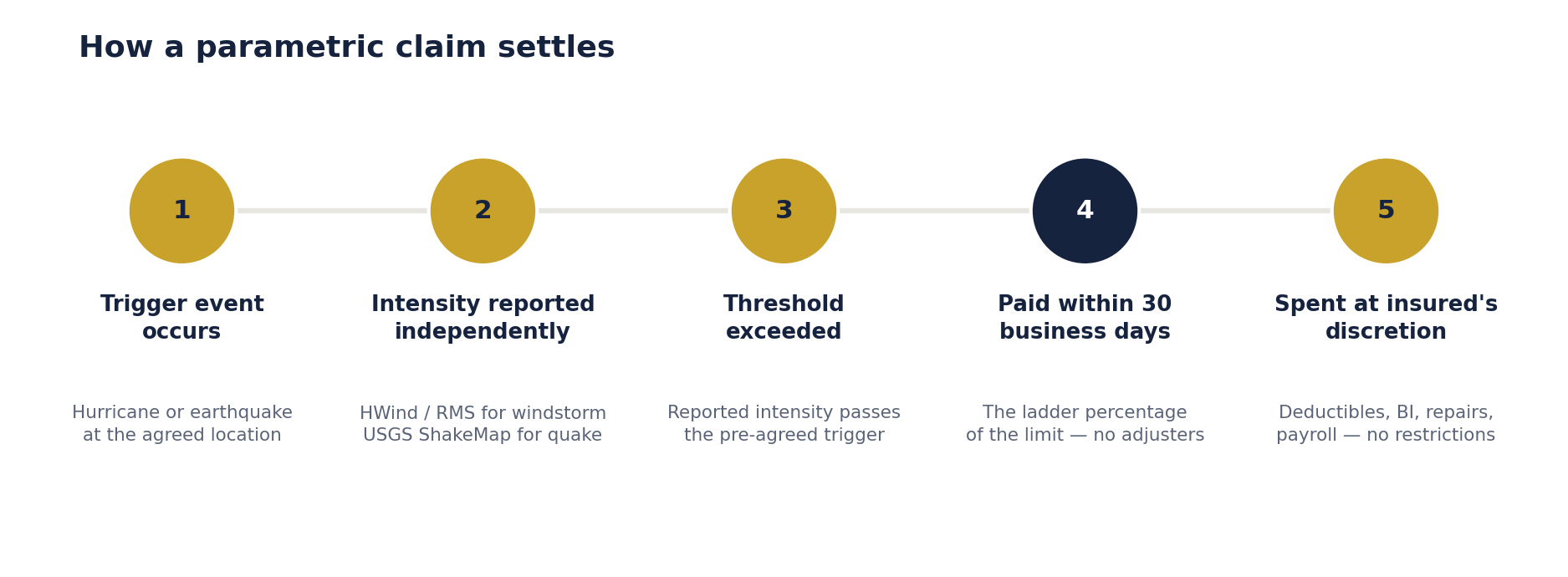
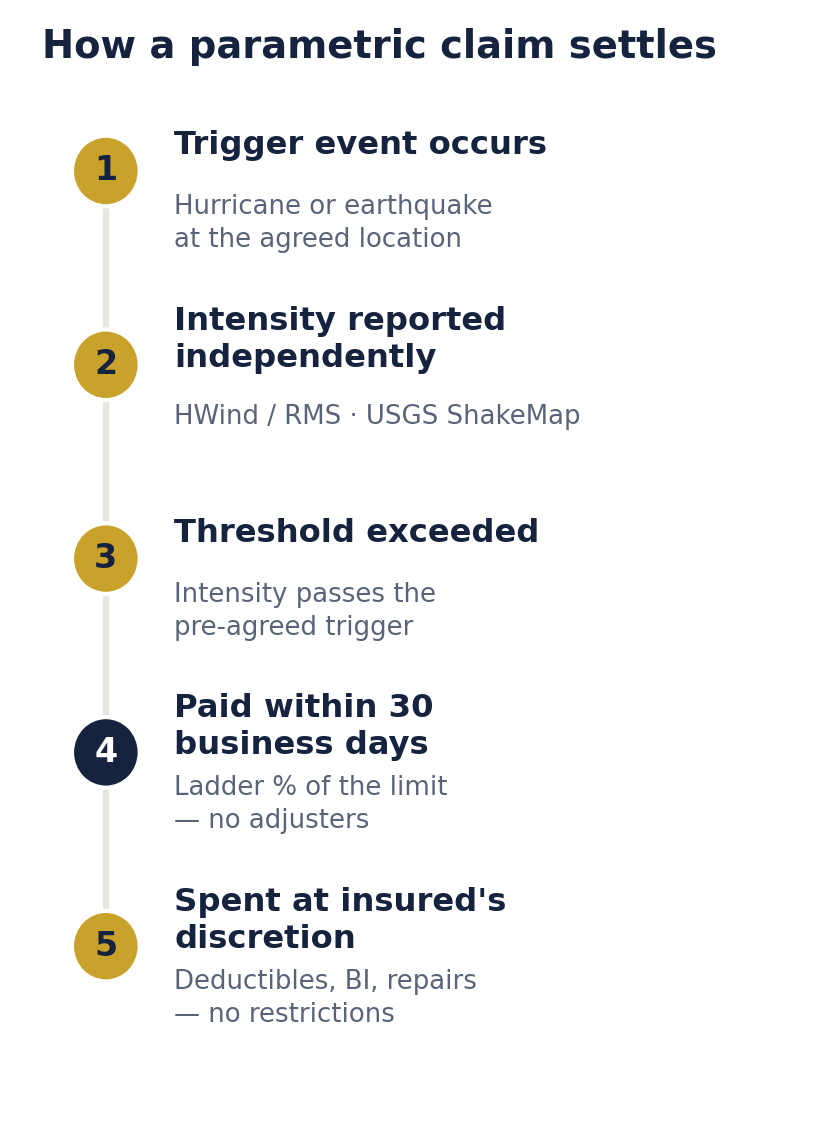
Because payment follows the parameter rather than an adjusted loss, the insured knows in advance exactly what each severity of event will pay, and receives funds while a conventional claim would still be waiting for a first site visit. The corollary is basis risk — the payout may not equal the actual loss — which is why the trigger ladder is designed around the client’s exposure rather than taken off the shelf.
What clients use it for
CAT deductible in-fill
Sitting against the 2–5% named windstorm and earthquake deductibles that leave insureds in these territories heavily self-insured.
BI without physical damage
Service interruption, loss of attraction, loss of ingress or egress — covered when the trigger is met, even with no damage to the insured’s own property.
Underinsured assets
Foundations, landscaping, docks and pontoons, light structures, debris removal — items conventional property programmes exclude or undervalue.
Post-event liquidity
Emergency costs, repairs and payroll in the weeks a conventional claim is still being adjusted.
A transparent claim
No adjusters and no attorneys — an independent agency’s published data settles the question, within 30 business days.
Flexible form and term
Written as an insurance contract or a derivative agreement, single or multi-year, per event and in the annual aggregate.
Worked example — a marina on Puerto Rico’s south coast
In December 2020 we produced a non-binding indication for the operator of a marina on Puerto Rico’s south coast, looking to protect against hurricanes and earthquakes. Two structures were indicated, each covering both perils as a combined single limit per event and in the annual aggregate, over a 12-month term at 100% share.
Option 1 — USD 1,350,000 limit. Named windstorm payouts begin at 95 mph (5% of limit) and reach 100% at 130 mph. Earthquake payouts begin at a peak spectral acceleration of 35%g (5%) and reach 100% at 105%g. Gross premium: USD 137,500.
Option 2 — USD 1,000,000 limit. Triggers start lower and climb faster: windstorm from 90 mph (10%) to 100% at 125 mph; earthquake from 30%g (10%) to 100% at 90%g. Gross premium: USD 137,500.
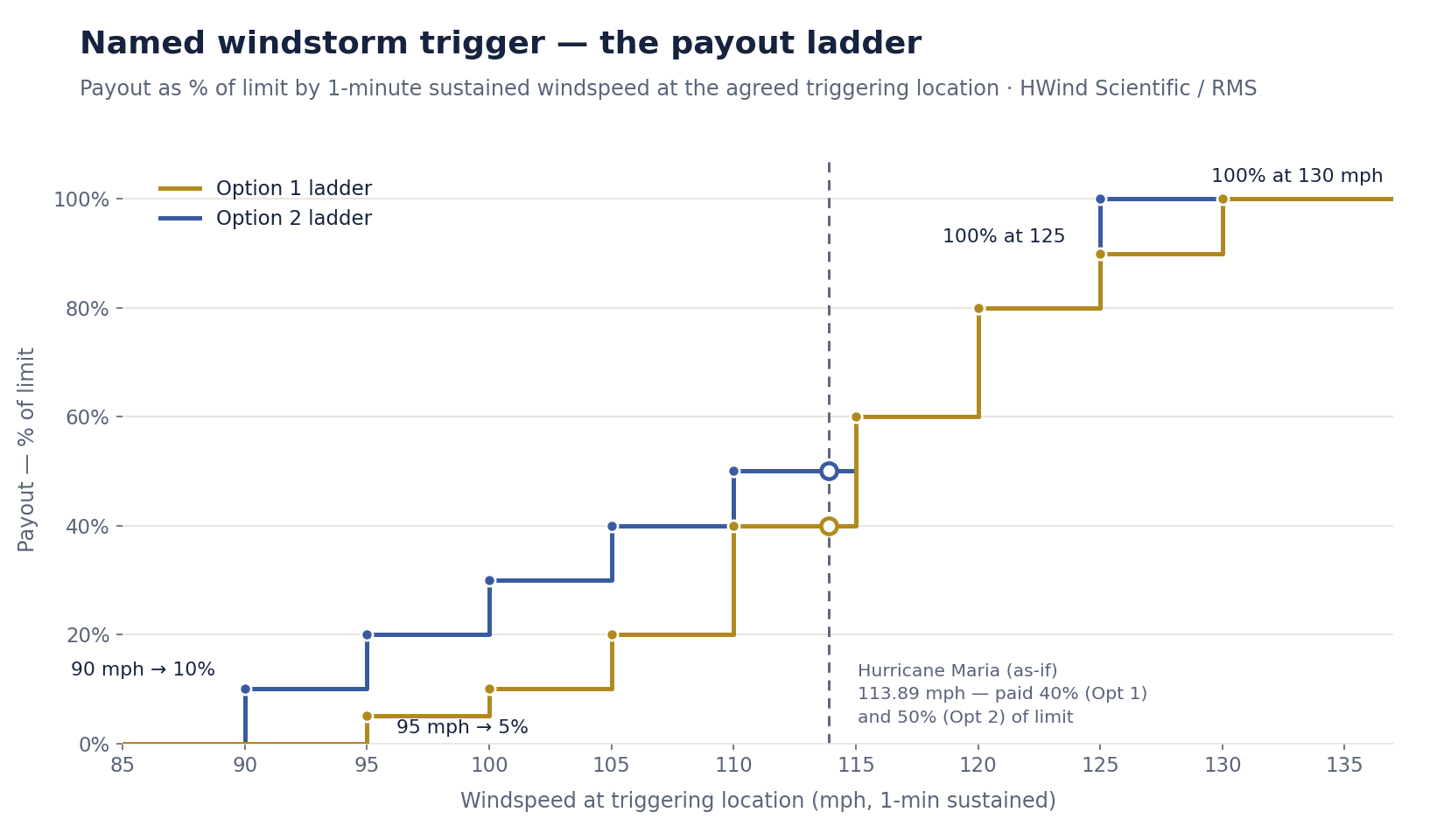
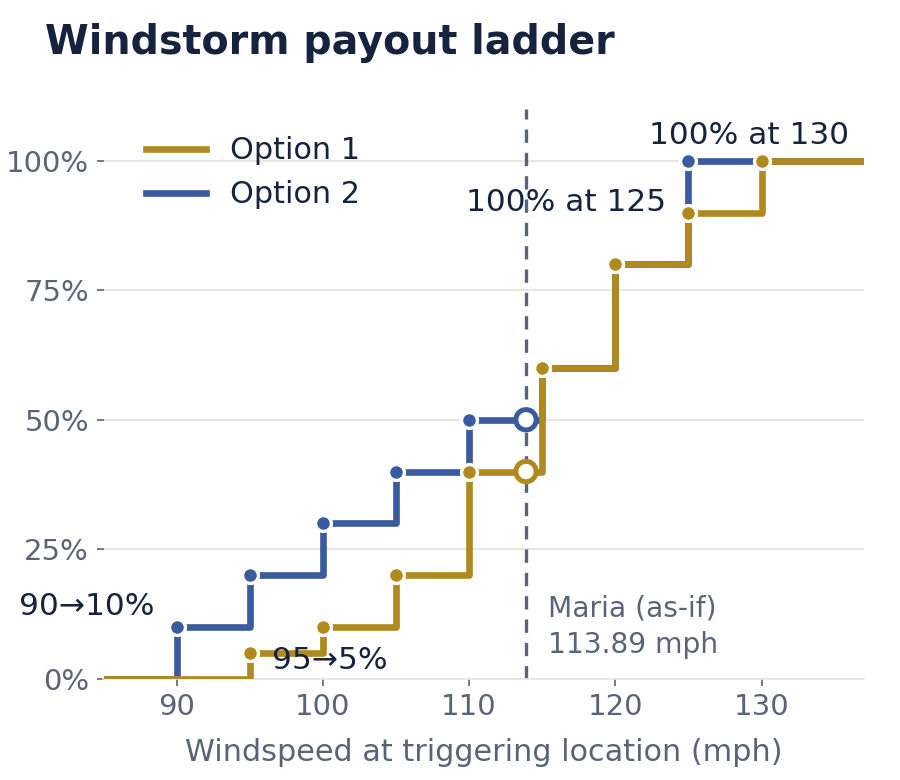
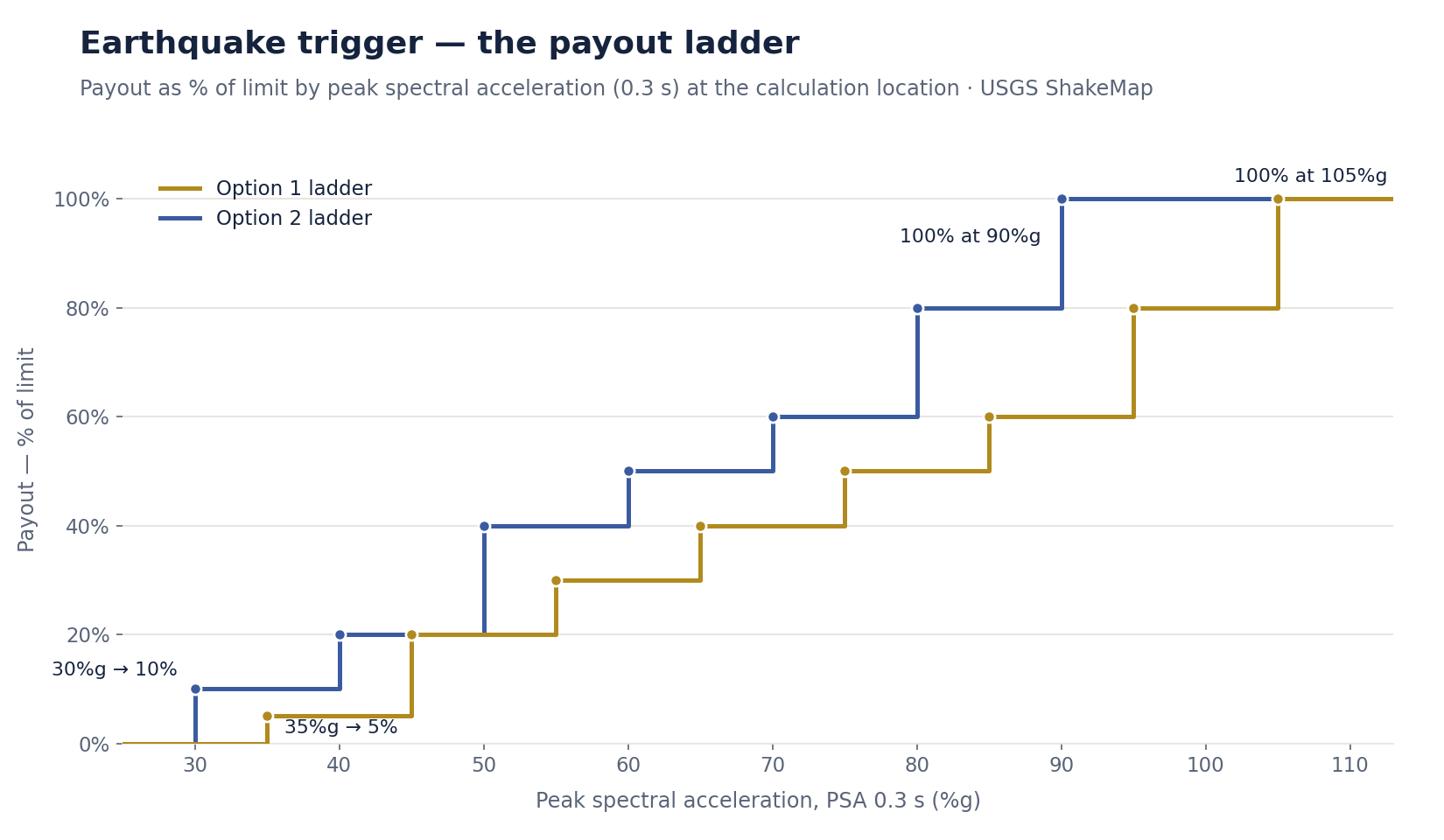
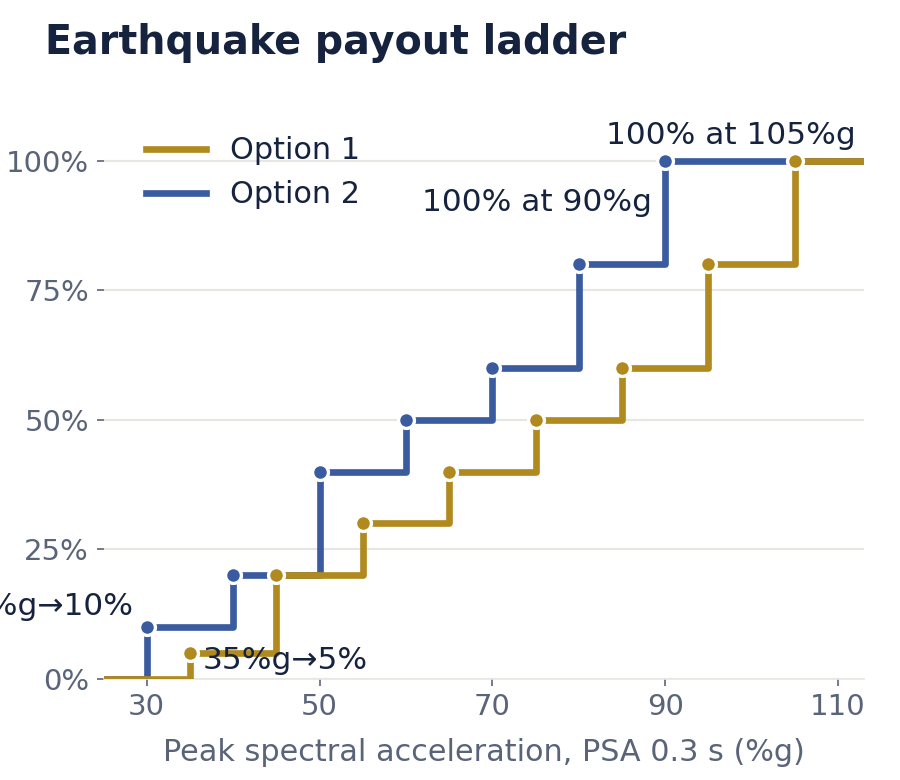
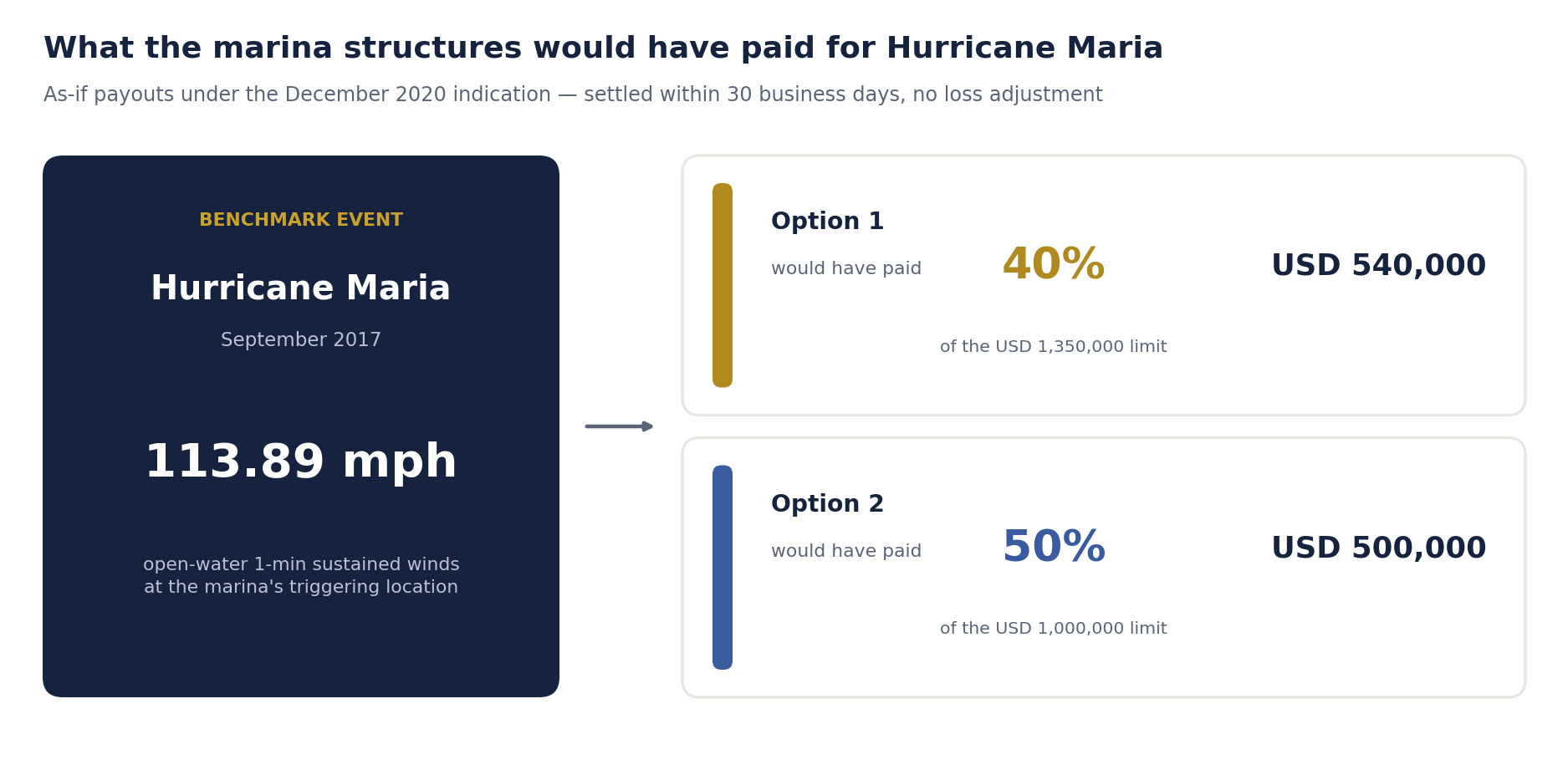
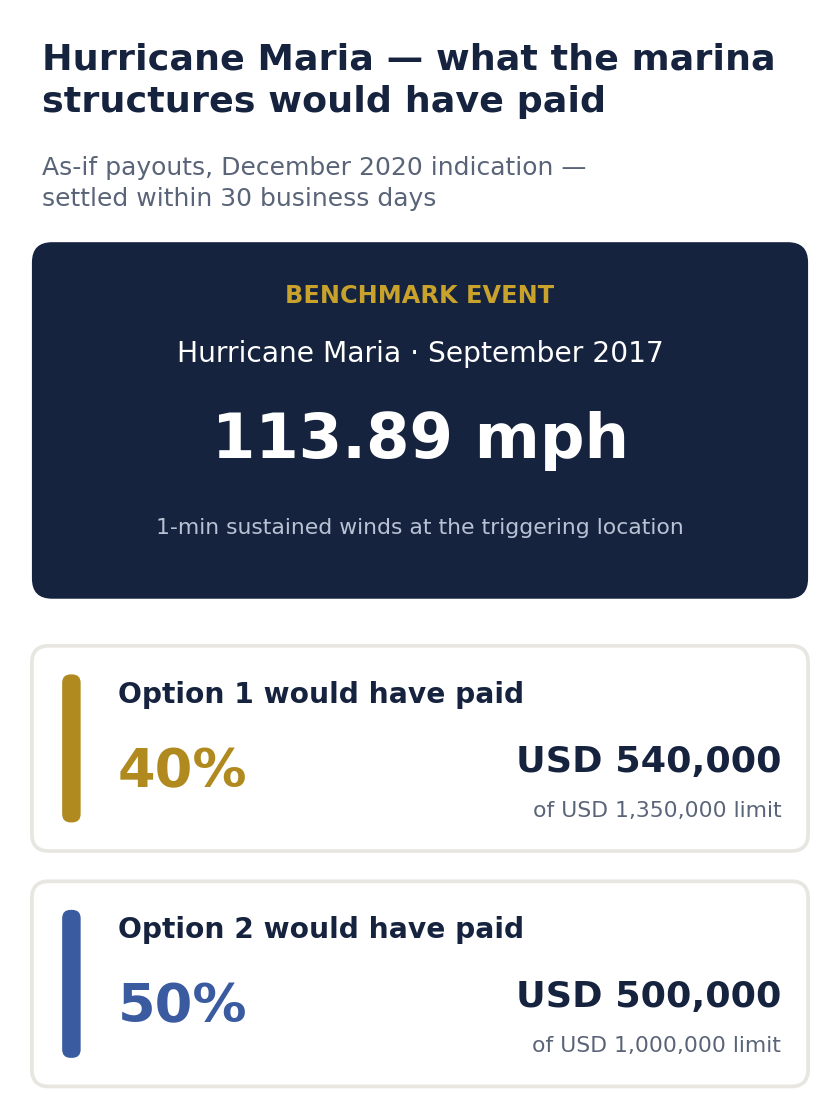
The two options carried the same premium — the choice is about shape. Option 2 buys earlier, steeper payouts on a smaller limit: more likely to pay, and to pay a larger share, in a moderate event. Option 1 preserves a third more limit for the severe tail. Benchmarked against Hurricane Maria — 113.89 mph open-water sustained winds at the agreed triggering location — Option 1 would have paid 40% (USD 540,000) and Option 2 50% (USD 500,000), in each case within 30 business days of the event.
Worked example — a beachfront condominium association in Isla Verde
In 2021 we quoted the same dual-trigger structure for a beachfront condominium association in Isla Verde, on Puerto Rico’s Atlantic coast — the same trigger ladders as the marina, priced for a different location and limit: Option 1, USD 1,250,000 limit at USD 105,000 gross premium; Option 2, USD 1,000,000 at USD 90,000.
For a condominium association, the appeal is practical: a parametric payout can fund the association’s windstorm deductible, emergency works and special-assessment gap while the conventional property claim develops — and the payout belongs to the association, to use at its discretion.
Reading the structures
- Triggers are measured at an agreed location — the nearest HWind gridpoint for windstorm; the USGS ShakeMap grid at the insured’s coordinates for earthquake — so there is no dispute about where intensity is assessed.
- The payout is the ladder percentage of the limit at the highest threshold the event reaches; limits apply per event and in the annual aggregate.
- Premiums shown are gross, exclusive of local fees and taxes; carrier and inception are confirmed at quote stage.
- The figures above are historical indications from December 2020 and 2021, anonymised, and shown for illustration only — pricing and terms move with the market.
Who we work with
We structure parametric cover for US retail and surplus lines brokers, local brokers across Puerto Rico and the Caribbean, MGAs, and cedents or captives using parametric protection as deductible in-fill or sideways cover. We act purely as your wholesale partner — your client relationships remain entirely yours.
What we need to quote
- The insured location, ideally geocoded — a street address is enough for us to work from.
- The perils to trigger — named windstorm, earthquake, or both combined.
- The limit sought, or the budget — we can shape the ladder to either.
- Preferred structure: per event and aggregate, single or multi-year.
- Context: the underlying programme and its deductibles, and what the payout needs to fund.
Timing matters
Parametric windstorm capacity tightens as the North Atlantic hurricane season approaches, and structures cannot incept once a named storm is in the basin — any occurrence in progress at inception is excluded. Submissions that reach us in the first quarter get the best of the market.
Capacity is arranged case by case with A-rated parametric markets, with the carrier confirmed at quote stage.
Talk to us about a parametric structure — send us the location, the perils and the budget, and we will come back to you quickly with an indication.
The examples on this page are anonymised, historical non-binding indications produced for clients in Puerto Rico in December 2020 and 2021. Data providers as quoted: HWind Scientific/RMS (windstorm) and USGS (earthquake). A parametric payout follows the measured parameter and may differ from the actual loss sustained.